
Vision for Strategy
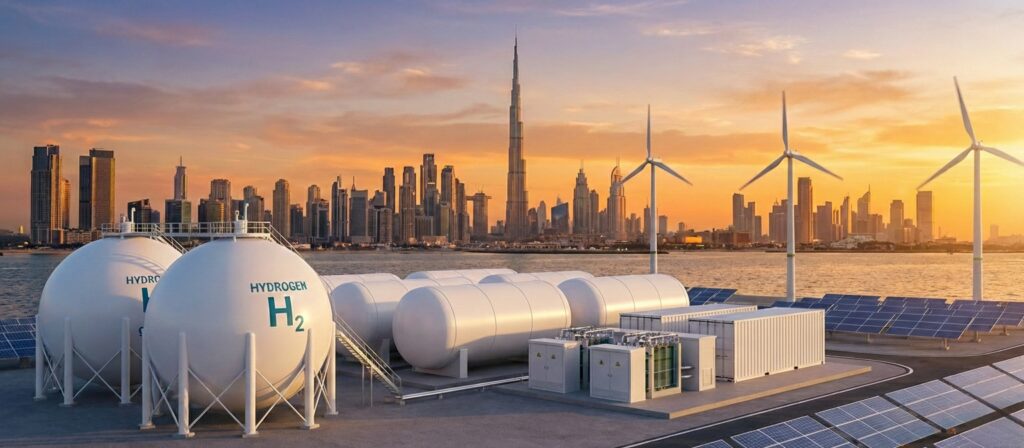
UAE Green Hydrogen Sector Overview
The United Arab Emirates has turned its National Hydrogen Strategy into a key pillar for ‘We the UAE 2031’ and ‘Net Zero 2050’, with quantitative targets that reflect its ambition:
- Double GDP to AED 3 trillion
- Increase non-oil exports to AED 800 billion
Green hydrogen in the UAE is closely linked to the nation’s economic growth, underpinned by state backing and a proven execution capacity.
Strategic Pillars
Record low solar LCOE values (approx. USD 0.013–0.014/kWh in recent projects) provide a cost base that supports long-term green hydrogen competitiveness.
National energy companies and institutions (such as ADNOC, Masdar, and ADQ) play a central role in project development.
The UAE positions itself alongside other major potential exporters such as Saudi Arabia, Oman, and Australia. Differences in solar resource quality, infrastructure maturity, and market access shape each country’s strategy.
| UAE | KSA/Oman | Australia | |
|---|---|---|---|
|
Solar LCOE |
USD 0.0135/kWh |
USD 0.017/kWh |
USD 0.024/kWh |
|
Infrastructure |
Mature & diversified |
In development |
Concentrated |
|
Geostrategic access |
Europe + Asia |
Mainly Asia |
Mainly Asia |
Access: Europe + Asia
Access: Mainly Asia
Access: Mainly Asia
Available opportunities
Sector Opportunities Overview
Project Structures:
Overview of consortia and public‑private partnership models referenced in recent UAE hydrogen projects, including typical roles for national champions, foreign investors, and technology providers. These examples illustrate how risk, infrastructure, and offtake are usually allocated in large‑scale developments.
Technology Trends:
High‑level description of current developments in electrolysis (alkaline, PEM, SOEC) and CCUS in the UAE and comparable markets. Focus on technology readiness, cost trajectories, and how these options are being combined in integrated hydrogen and ammonia projects.
Supply Agreements:
General data on long‑term offtake contracts for hydrogen, ammonia, and e‑fuels mentioned in public sources. Includes indicative tenors, counterpart profiles, and how export routes to Europe and Asia are being structured.
Digital Landscape:
Analysis of how online channels and information platforms support visibility and access to public data in the sector. Focus on transparency practices, data availability, and how stakeholders communicate sector developments.

🌱 Join Team
Be part of a brighter sustainable energy
We’re always looking for passionate innovators, engineers, and dreamers who share our vision of a cleaner planet powered by renewable energy. Let’s grow together.